Lowestoft
Lowestoft has a proud history as a fishing port, but
the decline of
this
industry in recent decades has left this large town on the mouth of the
River Waveney finding new roles apart from that of a seaside resort.
Railway Station, Station
Square
The
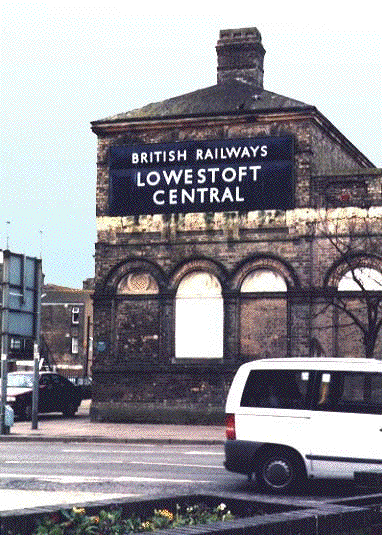
railway station (below) must have one of the few remaining British
Railways
enamelled ,metal signs in the country. It is in surprisingly good
condition, too. If
memory
serves British Railways was rebranded as 'British Rail' with its red
and
blue arrow logo during the late sixties (not to mention the nineties
massacre
of our rail services), so this sign must predate this. One would have
imagined
that, in its day, Railtrack would have replaced this sign - but it
could
be listed ... anyone know?
 c.2002
images
c.2002
images
The Railway Station at Lowestoft opened in 1847
and has been a popular stop for coastal holidays since the Victorian
era. The story we have chosen to reflect the spirit of this building is
that of the local station master, James W. Smith, who was promoted away
to Norwich. The local paper recorded his departure in 1900 and noted
how popular he and his wife were in the town, and that he would be
sorely missed. This story reflects the closeness of Lowestoft life in
the early 1900s, and the importance of the station staff within the
local community.
 2025
images
2025
images
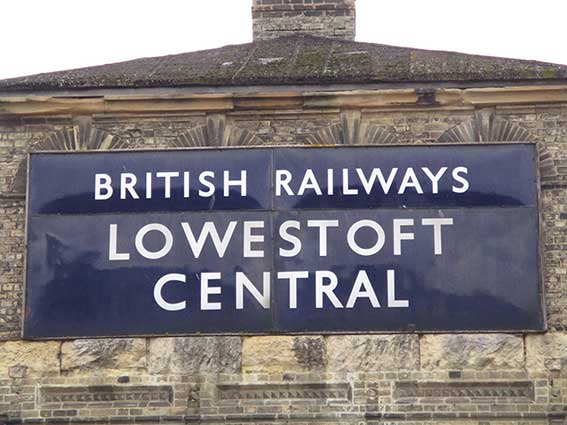
Above the huge enamelled station sign in 2025.
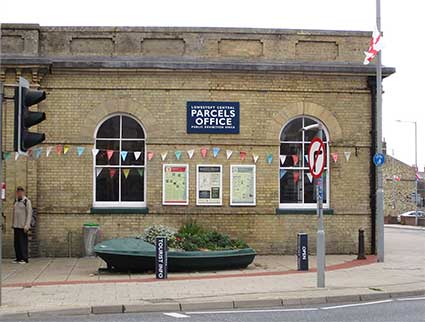
This shows that it appears to be an assemblage of four sections. Below:
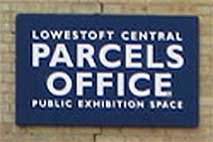
the station buildings to the right of this sign. The recent sign
reproduces the appearance of the old; nice to see the ue of 'Parcels
Office' to reflect the heyday of rail transport.
Former Tuttles Department Store,
London Road North/Waveney Road

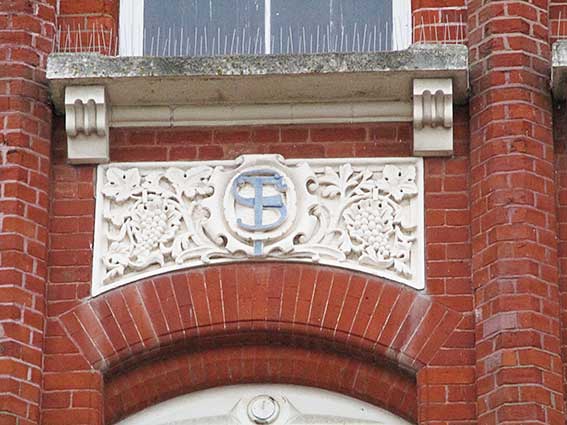
Above: the decorative panels above the first
storey windows feature vines and grape bunches, mirrored on each side
of a central cartouche bearing the monogram: 'TS', presumably standing
for Tuttles Store. The decorative cornice at the top of the building
features small obelisks topped by spheres – however, the third one
along from the left appears to be a lion holding a shield.
‘Tuttles Corner’ was a restaurant at street
level (although not signed as such any more) was a popular landmark on
the approach to Lowestoft town centre dating back to the late
1880s. It was named after the Tuttles Bon Marche department store that
had its base here until its closure in 1981. The building was acquired
by father and son Henry and Ebenezer Tuttle in 1886. Henry had
previously owned a number of grocery and provisions stores in various
areas of Lowestoft but had quickly outgrown them. In 1888, Tuttle &
Son opened their ‘BonMarche’ department store to the public. By1890,
Bon Marche had added a dressmaking department and in 1897 the whole
store was refitted to include sections such ashaberdashery, laces,
wool, hosiery, and accessories. Ebenezer Tuttle was a notable figure of
Lowestoft life. In 1891 he was elected as Town Councillor and by 1895,
he had been promoted to the Alderman bench. Ebenezer went on to be
Mayor of Lowestoft from 1904-1906. From 1911, he resided at Cliff House
in Kirkley and in December1921, Ebenezer died at London Road North
Methodist Church aged 70Today the large department store buildings are
occupied by a number of individual shops. The restoration of Tuttles
department store facades in 2024 was Highly Commended in the Quality of
Place Awards for its careful execution, ensuring the preservation of an
important piece of the town’s heritage.
See below for 'Tuttles Furniture Galleries'.
Bevan Street East
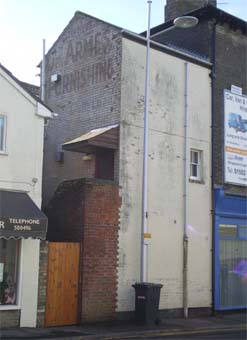
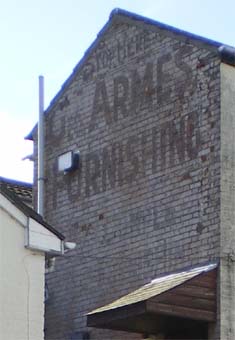
Not far from the station on Bevan Street East stands a
humble building, once a small furnishers:
'STOP HERE
GEO. ARMES
FURNISHING'
(then two lines of previous faded lettering including
the last word
'FURNISHING' just above the wood/tile porch).
 -
-
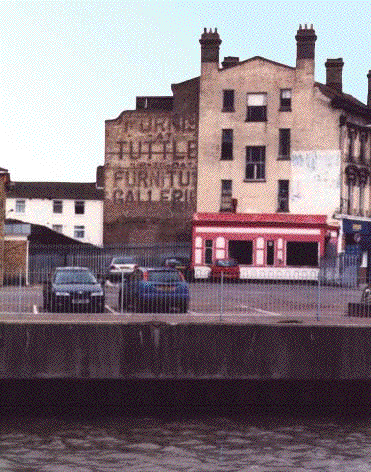
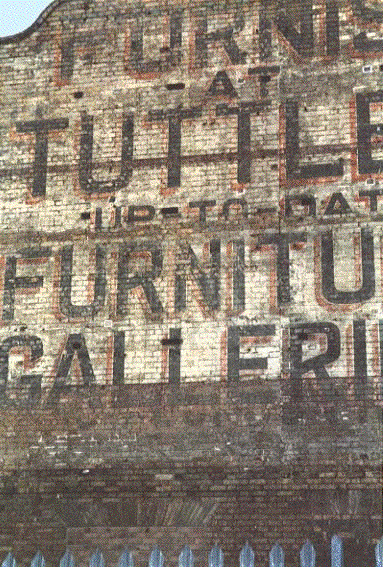
Proceeding towards the Bascule Bridge over the Waveney, we find another
furnisher's sign: a near-complete, massive
wall
advertisement.
'FURNISH
AT
TUTTLES
UP-TO-DATE
FURNITURE GALLERIES'
on a pale coloured painted area which doesn't quite
stretch below the
word
'Galleries'. There are signs of earlier lettering below this, too. The
concept
of a furniture gallery is a novel one. The typeface is unusual and has
an
orange drop shadow.
 -
- 2002/2008 images
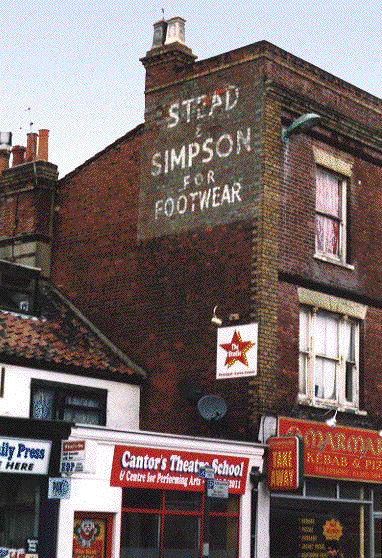
219-221 London Road South
Further down London Road South there is a
former shoe
shop:
'STEAD
&
SIMPSON
FOR
FOOTWEAR'
high on the wall on a paler (green?) panel. By 2025 the
lettering has been painted over.
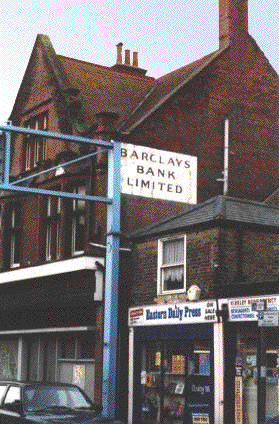
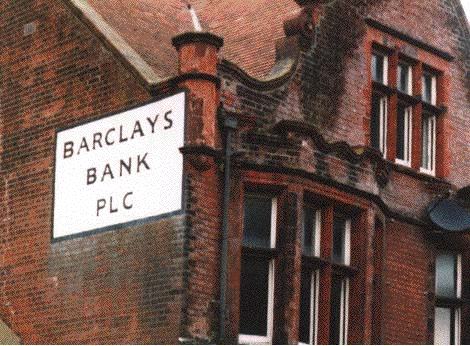
229 London Road South, former
Barclays branch
A little further still, an old Barclays Bank
branch, proudly signed
on each side. The white rectangle with black border is starting to wash
down on the brickwork below, but the sign is still remarkably clear
despite
the bank having long gone.
 -
-
See Beccles, Ipswich
Cornhill, and Felixstowe for more
bank lettering examples.
London Road North
From here we go northwards, back to 87-89 London Road North, where we
find the former Post Office building.
The lintel bears the incised legend: 'POST OFFICE' flanked on each side
by the monogram 'VR' (Victoria Regina).
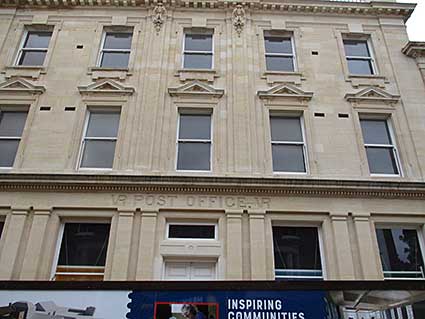
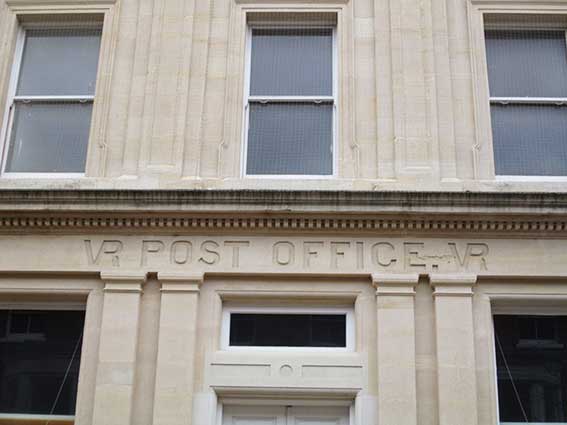
Lowestoft Post Office was originally a single storey building in the
1870s and was built upon in 1909 by C Roper. The old Post Office is
well known locally, having been the centre of the postal service in
Lowestoft for close to 150 years before its closure in 2016. Its
history as an iconic building in the town centre is long and varied.
The article from The Norwich Mercury
details a piece of that history – an attempted arson on the building in
1893, where someone had thrown a match into the building’s letter box,
destroying some twenty letters.
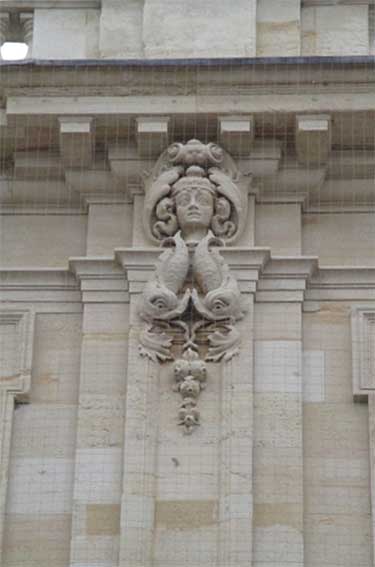
High up under the modillion cornice are two extraordinary
'cayatid'-confections drawing on the nautical and maritime roots of the
town. A classical female head with S-shaped locks on each side which
resemble Neptune's horses. Wave-like forms enclose the head which has a
head-dress and top-knot. The scrolling feature at the top even has a
central which seems to have a dog-like face. Dropping down from the
neck are two grotesque fishes with large open mouths with serpentine
tongues bracketed by acanthus-like leaves. Below that are pendant
pomegranates. One heck of a decoration on a Post Office.
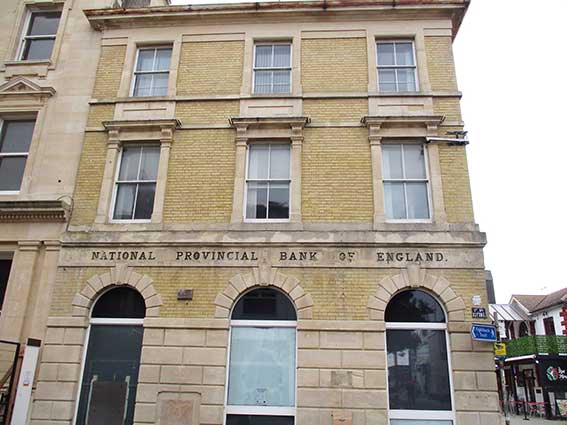
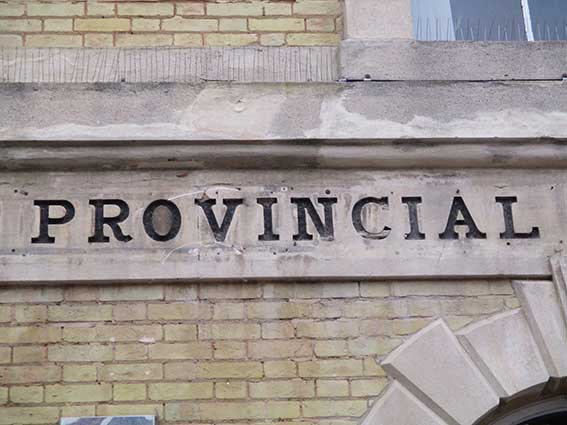
And adjoining, at no. 58, is the:
'NATIONAL PROVINCIAL BANK OF ENGLAND'
until recently, these incised and coloured capitals
were coverd by a plastic 'NATWEST' sign.
High Street
Lowestoft’s original town centre. In Old Norse, the name Lowestoft is a
combination of the personal name Hloðvér and toft, translating into
‘homestead’ or ‘dwelling’. According to the Domesday Survey of 1086
Lothuwistoft began as a small agricultural village consisting of no
fewer than sixteen dwellings. The oldest part of Lowestoft is situated
upon the old clifftop in the north around the historic High Street.
127 High Street
 2024 image courtesy Mark Beesley
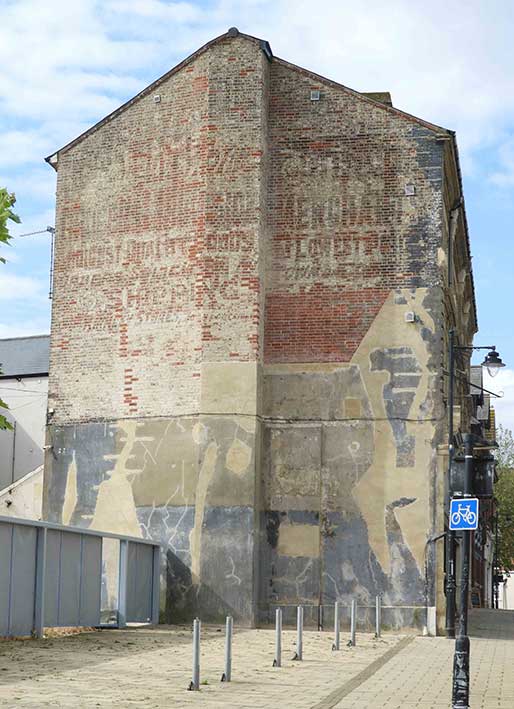
On the side wall facing south down High Street (and close to the
junction with St Peters Street) is this enormous adverting sign – or
rather, palimpsest of a number of trading signs. Thanks to Mark Beesley
for send ing this. Checking the locayion on StreetView reveals that, in
2022, a large fabric canopy lined this part of the street, obscupring
the view of the sign. For years the upper part of this wall was covered
with black paint with, below, the partial words:
'ONS LTD.' and 'PROVIS[IONS]'
in condensed caps with a red drop-shadow. It appears
that a great deal of cleaning has followed which largely expunged these
characters, but revealed layers of partial sgns on a layer of cream
cloured paint. In 2024 much more lettering is revealed with randome
words partially readable:
'HIGHEST[?] QUALITY [G]OODS ... URNERS ... SHIPPING ... MERCHANT ... OF
LOWESTOFT ...' and, at the top right, what appears to be the Lombardic
capital 'T' (similar to the first letter of 'Telegraph' at the top of
the newspaper). This riot of signs requires more work and research to
untangle; we can't find it on the other specialist ghost sign websites.
[UPDATE 14.1.2025: 'On
the large sign at 127 High Street, Lowestoft, there are a few more
words I can help with, I think The very bottom line on the left says
Kirkley Stores, Lowestoft, and on the other side of the chimney breast
at a similar level it says "town". Tom Ayres.' Thanks, Tom. He also
contributed two vestigial examples on the Crown Hotel. Crown Street
East.]
Crown Hotel, 150 High Street
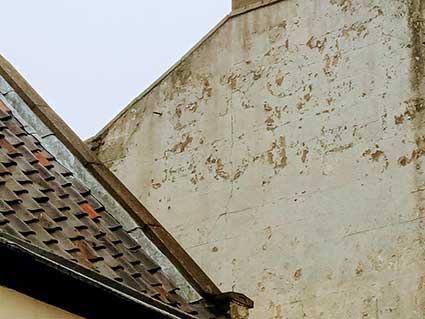
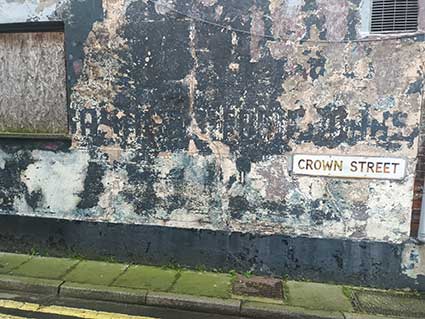
This inn, later a hotel, is in 2024 in a
dilapidated state giving only a hint of its past importance in
Lowestoft. Suffolk CAMRA (see Links) dates
the inn back to at least 1764. It closed in 2009. Tom Ayres writes:
'...
on the Crown Hotel; first one is of the name of the hotel itself, then
something totally illegible to me on the lower part of the same wall on
the south side of the hotel building. Not sure if it would be related
to the hotel or another business.' These examples can be viewed from
Crown Street East.
 2024 images
Above images courtesy Tom Ayres.
The Crown Hotel was built in the 17th century and was a public
tavern and also part of a larger business owned by Youngman and Preston
from 1872.The owners had stakes in multiple properties attached to the
Crown, including the Eagles Brewery. Built in 1856, it was one of the
leading ale-makers in Suffolk. By November 1904, the brewery was sold
for £40,278 to County of Suffolk Gentlemen and The Trustees. The
brewery finally closed in 1922.
81 High Street
 2025 images
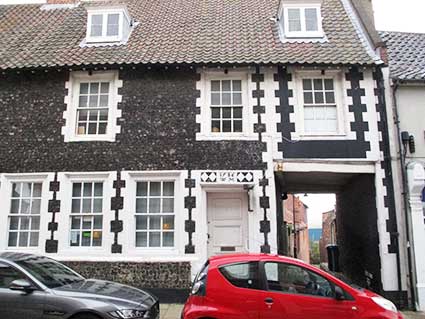
This ancient, knapped flint-fronted building,
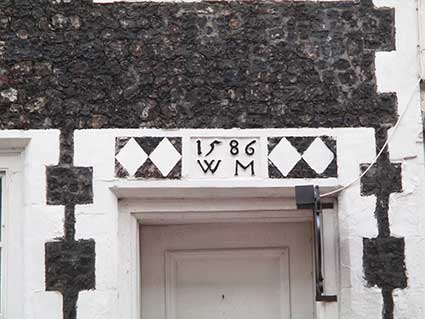
The Flint House, bears a stone lintel:
'1586
W M'
It is one of the oldest buildings on this street and
was originally the home of William and Mary Wilde.– which explains the
'W' and 'M' over the door. The house has a first storey over Wilde's
Score, one of seven passageways (elsewhere in
the country called 'ginnels') running down towards the sea. This was
named after the Wilde family who lived in the Flint House from 1588 to
the 1740's when John Wilde left in trust, money for the building of a
school-house for the free education of boys from fishing families. £40
per year was left for maintenance and the salary of a 'virtuous and
learned schoolmaster who shall teach 40 boys to read, and write, and to
cast accounts: and also teach them the Latin tongue'. A school remained
here until World War II when the pupils were evacuated. It was then
used by the Air Training Corps and later bombed. Part of the old school
still stands which the Lowestoft Civic Society has converted into a
heritage centre for the community. The bottom of the Score was blocked
and the cottages demolished to allow the development by Birds Eye. The
Score now turns right into Cumberland Place and then winds down past
the shoal of herring to Whapload Road.
[Source: Great Yarmouth Preservation
Trust]
Witchcraft was allegedly
performed on Wilde’s Score and the High Street during the 17th Century.
These rituals were the work of local women Amy Denny and Rose Cullender
who were accused of cursing the town following troubles and disputes in
the local fishing industry. In the 1660s Denny and Cullender were
placed on trial at Bury St Edmunds court where they were sentenced to
execution by hanging.
The Scores. Historical Lowestoft’s earliest dwellings were close
to the beach, but it soon became clear that flooding and erosion made
this a hazardous place to live. By the 14th century, the Lord of the
Manor ordered all residents to relocate to the top of the cliffs. This
was also problematic as locals had to cross the cliff to move supplies
to and from the town and the sea port. Gullies began to form naturally
along the cliff faces. These gullies would come to be the present-day
seven high street Lowestoft Scores. Many scores have changed name over
time. Crown Score may have been named Lion Score, where the Red Lion
Public House stood until 1898. Mariner’s Score lay at the crossroads
beside Bayfield’s. This score is notable for its original name of
Swan’s Score names after the Swan Inn. While the larger scores such as
the Ravine were natural clefts in the landscape, some narrower ones
were gradually formed by fish merchants to give access from their homes
on the cliff to their net stores and fish houses below on the beach.
133 High Street
This address includes the two bays on either
side boasting decorative, stained-glass ovals. Sadly, the shop has long
been abandoned. It stands opposite today's Mayfly Café.
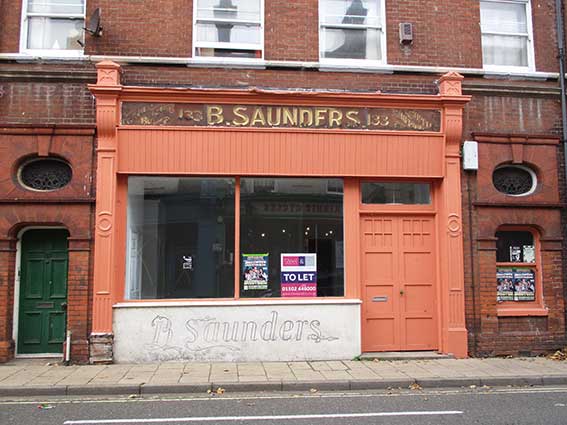
'FAMILY BUTCHER
133
B.SAUNDERS.
133
SUPPLYING SHIPPING'
The proprietor's name is
repeated below in decorative cursive script.

138 High Street
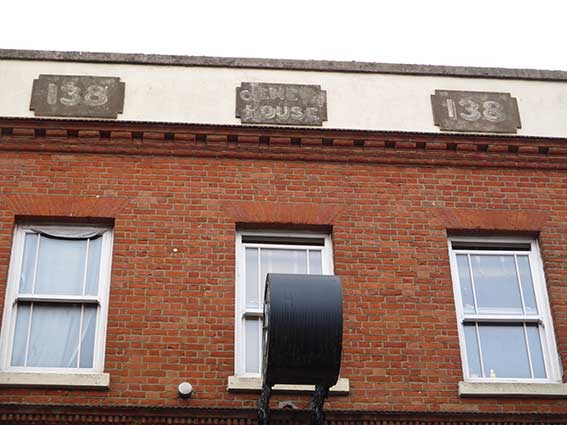
High up on the parapet are three cartouches (the centre one rather
weathered):
'138'
CHENEY[?] HOUSE '138'
Kendal Road
On Kendal Road which runs from the Pakefield end
of
London Road South
towards the Fisheries Research Establishment stands this remarkable
example of trade lettering:
'METAL COATING MOTORS LTD.
Diesel & Motor Engineers.'
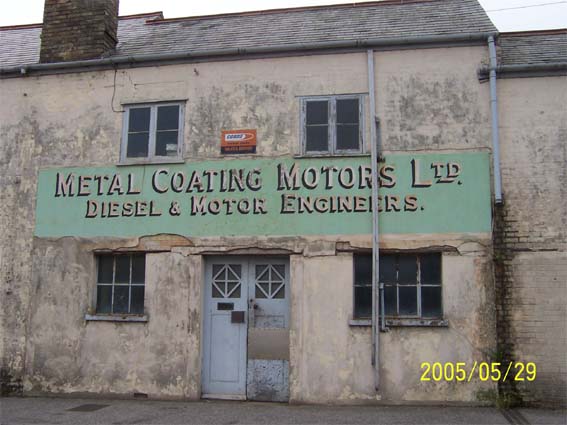
The firm is still in operation, and someone has done
a fine paint
job on the green background (despite the down pipes), even though the
frontage has seen better days. It seems - however unlikely - that the
signwriter has returned to earlier lettering and painted round existing
characters. The drop-shadow small and large caps have that weathered
look to the face of the font which gives a suitably distressed metallic
look to
the sign. Ten out of ten.
[Additional information on this page came from https://suffolkarchives.shorthandstories.com/high-street-history-lowestoft/index.html].
Home
Return to Historic Lettering from outside
Ipswich
Please email any comments and contributions by clicking here.
Search Ipswich
Historic Lettering
©2004 Copyright
throughout the Ipswich
Historic Lettering
website: Borin Van Loon
No reproduction of text or images without express
written permission